
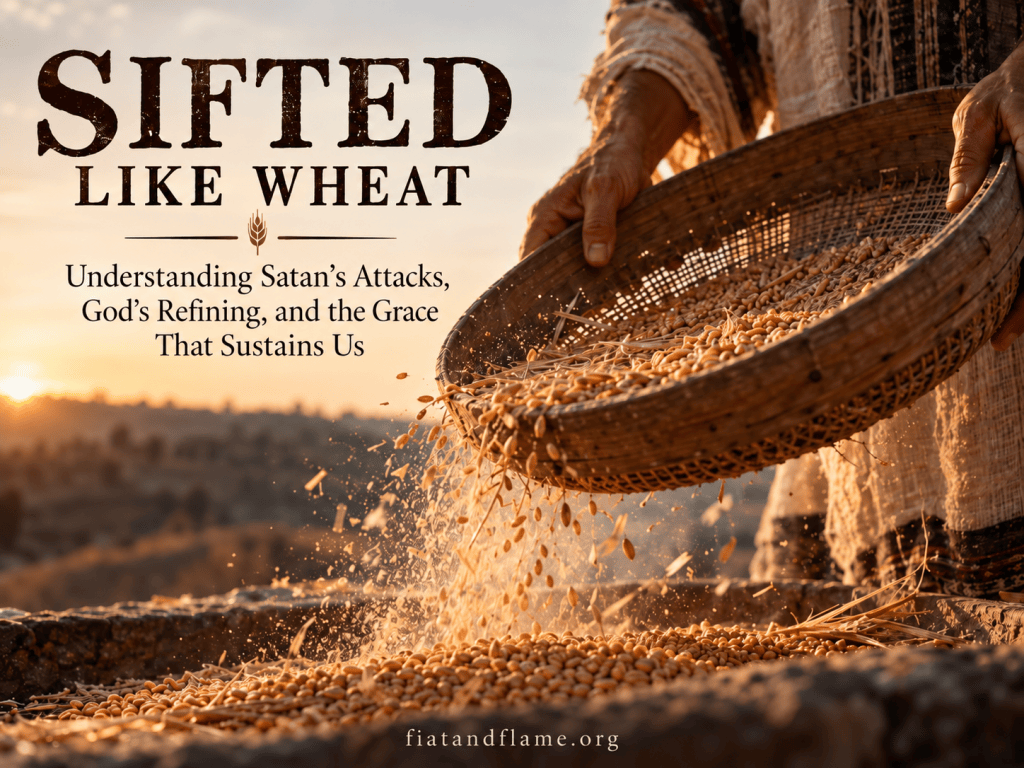
Understanding Satan’s Attacks, God’s Refining, and the Grace That Sustains Us
“Simon, Simon, behold Satan has demanded to sift all of you like wheat.” — Luke 22:31
Have you ever experienced a season of life when everything seemed to be shaking? Your confidence, your relationships, your sense of purpose, perhaps even your faith? Sometimes the difficulties come so relentlessly that you begin to wonder whether God is trying to teach you something, whether you are under spiritual attack, or whether you are simply experiencing the unavoidable hardships of life.
Jesus’ words to Simon Peter offer us a profound understanding of spiritual trials and, more importantly, the assurance that we are not left to face them alone.
What Did It Mean to Be Sifted Like Wheat?
When Jesus spoke these words, He used an image that His disciples would have understood immediately.
In ancient Israel, wheat processing was a familiar and physically demanding part of agricultural life. After the wheat was harvested, it was taken to a threshing floor, where the grain was loosened from the stalks by trampling or threshing implements. The mixture was then winnowed, tossed into the air so that the wind could carry away the lighter chaff while the heavier grain fell back to the ground.
But the process was not finished.
The wheat still contained bits of straw, dirt, small stones, and other impurities. It needed to be sifted. The grain was placed in a sieve and shaken repeatedly, sometimes quite vigorously, to separate what was useful from what was not.
Imagine the motion: back and forth, side to side, the grain being tossed and shaken as the remaining unwanted material was separated.
The disciples would have recognized the intensity of this image. They knew that sifting was not a gentle process.
Yet Jesus was describing something far more serious than agricultural separation. He was warning His disciples of Satan’s intention to shake their faith.
There is an important detail in the original Greek. Although Jesus addresses Simon by name, the word translated as “you” in verse 31 is plural. Satan had demanded to sift all of the disciples, not Peter alone.
And the events about to unfold would shake every one of them.
Satan’s Intention Was Not Refinement
We sometimes hear Christians describe difficult experiences as God’s refining process, and Scripture certainly teaches that trials can strengthen and purify our faith. But we must be careful not to confuse God’s intentions with Satan’s.
Satan does not attack us to make us stronger. He attacks to draw us away from God.
His desire is to undermine our trust, weaken our resolve, encourage sin, and ultimately separate us from the One who gives us life.
The Apostle Peter himself would later warn Christians to remain vigilant against the devil, who seeks to devour rather than nurture (1 Peter 5:8–9).
But God’s purpose is entirely different.
The Letter of James makes an essential distinction. Although trials can produce perseverance and spiritual maturity, God does not tempt anyone to evil (James 1:2–4, 13–15).
The Catechism of the Catholic Church explains in paragraphs 2846–2847 that the Holy Spirit helps us distinguish between trials that contribute to spiritual growth and temptations that lead toward sin and death.
The distinction matters.
God may allow us to encounter suffering, adversity, or temptation, but He never desires our sin. Nor is He the author of moral evil.
He desires our salvation, our holiness, and our communion with Him.
Can God Use Satan’s Attack for Good?
Absolutely. And this may be one of the most consoling truths of the Christian faith.
The Book of Job gives us a powerful example. Satan sought to destroy Job’s faithfulness by attacking the circumstances of his life. His intention was to turn Job against God. Yet the narrative makes clear that Satan’s power was limited and subject to God’s authority (Job 1–2).
Job suffered greatly, and he did not receive an immediate explanation for his suffering. His story reminds us that faithfulness does not guarantee a life without hardship and that suffering is not necessarily punishment for personal wrongdoing.
It also shows us that Satan does not possess unlimited authority over God’s creation.
The Catechism affirms this in paragraph 395, teaching that Satan’s power is finite and that even his destructive activity remains subject to divine providence.
We should not misunderstand what this means. God does not make evil good simply by allowing it. Rather, His goodness and power are so great that He can bring good even from evil.
The Catechism teaches precisely this in paragraphs 311–312. God is not the cause of moral evil, yet He can draw good from its consequences.
We see this truth most clearly in the Cross.
The betrayal, condemnation, and crucifixion of Jesus involved terrible human sin and injustice. Yet through Christ’s Passion, Death, and Resurrection, God brought about our redemption.
The greatest act of evil became the occasion for the greatest gift of grace.
Saint Paul expresses this confidence in Romans 8:28, assuring us that God works for good in the lives of those who love Him and are called according to His purpose.
This does not mean every painful circumstance will produce an obvious benefit, or that we will always understand why God permitted it.
It means that evil does not have the final word.
How Can We Tell the Difference Between God’s Refining and Satan’s Attack?
This is where spiritual discernment becomes so important.
We cannot always identify the spiritual cause of our circumstances. An illness, a family conflict, financial hardship, or a season of emotional exhaustion should not automatically be interpreted as a satanic attack. We live in a fallen world, and human weakness, natural circumstances, and the choices of others all affect our lives.
Sometimes a genuine trial and a spiritual temptation occur together. A difficult circumstance may expose our weaknesses while also presenting the temptation to despair, resent God, or abandon our commitments.
Rather than becoming preoccupied with determining the hidden origin of every hardship, we can ask a more useful question:
What is this experience inviting me to believe, choose, and become?
Satan’s temptations draw us toward distrust, deception, resentment, despair, or separation from God. They may tell us that our failures are unforgivable, that prayer is pointless, or that God has abandoned us.
God’s grace, even when it reveals uncomfortable truths about ourselves, calls us toward repentance, humility, perseverance, love, and a deeper dependence on Him.
There is a difference between the temptation that says, You have failed, so there is no point in returning, and the grace that says, You have fallen; turn back to Me.
But discernment is not always as simple as judging how something feels. Genuine repentance can be painful. Growth can involve uncertainty. Peace does not necessarily mean the absence of grief or struggle.
That is why the Church encourages prayer, Sacred Scripture, participation in the sacraments, and wise spiritual counsel. Through these ordinary means of grace, we learn to recognize what draws us toward Christ and what leads us away from Him.
The question is not always whether we are being shaken.
It is whom we will turn toward while the shaking continues.
Jesus Did Not Promise Peter an Escape
Return now to that extraordinary conversation in Luke 22.
Jesus warned Peter that Satan had demanded to sift the disciples. Yet He did not promise that Peter would be spared the coming ordeal.
Instead, Jesus told Peter that He had prayed for his faith, and that after turning back, Peter was to strengthen his brothers (Luke 22:32).
Consider the tenderness and significance of those words.
Jesus already knew Peter would deny Him three times. He knew Peter’s confidence would collapse under fear. He knew that the disciple who declared himself ready to die alongside Him would soon insist that he did not even know Him.
And yet Jesus also anticipated Peter’s return.
Peter’s denial was a genuine failure, but it was not the end of his story.
After the Resurrection, Jesus restored Peter and entrusted him with the care of His flock. In John 21:15–19, Peter’s threefold profession of love answers his earlier threefold denial.
Peter would go on to strengthen his brothers, just as Jesus had commanded.
Here we see how God can bring spiritual growth out of even a painful failure without ever having desired the sin itself.
Peter learned something about the limits of his own strength. He also came to know more deeply the mercy and faithfulness of Christ.
His restoration did not erase his past, but grace gave him a future.
Sustained Through the Shaking
There is another truth here that we should not overlook.
Sometimes God’s work in our suffering is not immediately visible as growth or strength. Sometimes His grace is sustaining us while we are still weak, frightened, grieving, or uncertain.
Saint Paul experienced this when he repeatedly prayed for relief from what he called a thorn in the flesh, which he also associated with a messenger of Satan.
The Lord answered him:
“My grace is sufficient for you, for power is made perfect in weakness.” — 2 Corinthians 12:9
Paul was not promised the removal of every hardship. He was assured of sufficient grace.
The same truth applies to us.
God can sustain us through prayer, the Eucharist, reconciliation, the encouragement of others, and the quiet workings of His grace. He may strengthen our endurance, reveal our need for help, or lead us to abandon a false confidence in our own abilities.
And sometimes the faithful response to suffering includes seeking medical care, accepting support, establishing boundaries, or removing ourselves from harmful circumstances. Trusting God’s providence does not require us to remain in preventable danger.
God’s strength is not measured solely by how much suffering we can withstand.
Sometimes it is revealed in our willingness to acknowledge our weakness and receive His help.
The Wheat Is Still Precious
Perhaps the most beautiful part of Jesus’ warning is not the reference to Satan’s demand, but the assurance that follows.
Jesus had already prayed for Peter.
Before the denial, before the tears, before Peter had even realized the depth of his weakness, Christ was interceding for him.
The shaking would be real. Peter’s failure would be real. But God’s mercy would be real, too.
We should never romanticize suffering or imagine that God delights in watching His children struggle. Nor should we assume that every difficult season has been personally arranged to teach us a lesson.
What we can trust is that no suffering, no temptation, and no attack lies beyond God’s knowledge or His power to redeem.
The same Peter who once heard Jesus’ warning would later encourage suffering Christians with the assurance that the God of all grace would restore, confirm, strengthen, and establish them (1 Peter 5:10).
Peter knew something about restoration.
He had lived it.
When we find ourselves shaken, perhaps the most important question is not, Why is this happening to me? Sometimes that answer may remain hidden.
Perhaps we should also ask, Lord, how can I remain close to You through this?
Because our hope does not rest in our ability to endure every trial perfectly. It rests in the faithfulness of Jesus Christ, who intercedes for us, calls us back when we fall, and offers us the grace to persevere.
Satan may seek to shake our faith, but he cannot prevent God from sustaining those who turn to Him.
And even when we have fallen, Christ still calls us to return.
A Question for Reflection
When life has shaken your faith, have you found yourself listening more closely to the voice of discouragement—or to the voice of Christ calling you to trust Him?
Scripture and Catechism References
Sacred Scripture — New American Bible, Revised Edition (NABRE)
- Luke 22:31–34, 54–62 — Satan’s demand to sift the disciples, Jesus’ intercession, and Peter’s denial.
- John 21:15–19 — Peter’s restoration and his commission to shepherd Christ’s flock.
- Job 1–2 — Job’s suffering, Satan’s accusations, and the limits imposed upon him.
- James 1:2–15 — Perseverance in trials and the teaching that God does not tempt anyone to evil.
- 1 Peter 1:6–7; 5:8–10 — Faith tested through suffering, resistance to the devil, and God’s promise of restoration.
- Romans 8:28–39 — God’s providence and the inseparable love of Christ.
- 2 Corinthians 12:7–10 — God’s sustaining grace in human weakness.
Catechism of the Catholic Church
- CCC 2846–2848 — Distinguishing spiritual trials from temptations, and seeking God’s help to persevere.
- CCC 309–312 — Divine providence, the mystery of evil, and God’s ability to bring good from evil.
- CCC 395 — The limitations of Satan’s power and its subjection to divine providence.
Scripture references are drawn from the United States Conference of Catholic Bishops. Catechism references are from the official teaching of the Catholic Church.


Leave a Reply