
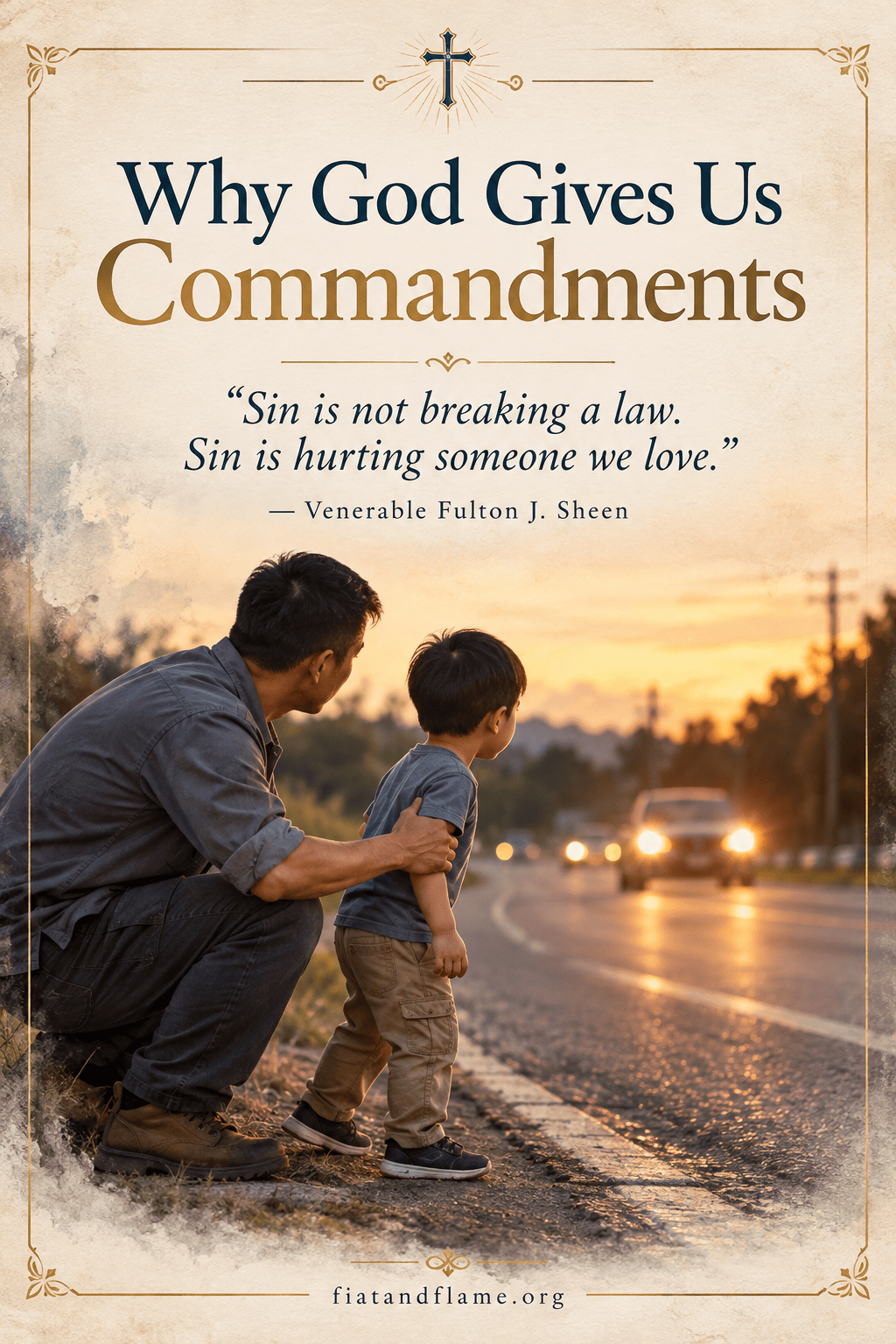
“Sin is not breaking a law. Sin is hurting someone we love.”
— Venerable Fulton J. Sheen
Sometimes Christianity can begin to feel like a list of rules. We hear what we should do, what we should avoid, what is sinful, and what is expected of us. If we are not careful, faith can start to feel like a system of behavior management rather than a relationship with the living God.
Venerable Fulton J. Sheen offered a much deeper way of understanding sin when he said, “Sin is not breaking a law. Sin is hurting someone we love.” That changes the entire tone of the conversation. Sin is not merely about violating an impersonal rule. It is about damaging a relationship.
Even the biblical language helps us see this more clearly. The Greek word commonly translated as “sin,” hamartia, carries the sense of missing the mark, failing to reach what is intended, or going astray. The Hebrew words translated as sin carry similar ideas of missing, failing, rebelling, or turning away. The words themselves do not literally mean “separation,” but Scripture repeatedly describes separation as one of sin’s deepest consequences. Isaiah says, “your iniquities have made a separation between you and your God” (Isaiah 59:2). Sin is therefore more than a technical violation. It is a movement away from the One for whom we were created.
Jesus Himself connected obedience with love when He said, “If you love me, you will keep my commandments” (John 14:15). His commandments are not arbitrary restrictions imposed by a distant God. They teach us how to live in right relationship with Him and with one another. When God tells us not to lie, steal, misuse sexuality, worship idols, or harm our neighbor, He is not simply testing whether we will obey. He is protecting what is good, true, and loving.
A parent gives rules to a child for much the same reason. A parent may say, “Do not play in the street,” or, “Come home before dark.” The child is not being asked to obey those rules merely to gratify the parent or prove loyalty. The rules exist because the parent can see dangers the child may not fully understand. The parent is pleased when the child obeys, not because obedience feeds the parent’s ego, but because the child is choosing something that protects his or her well-being. In the same way, the parent is saddened when the child ignores those boundaries, not simply because a rule has been broken, but because the child has moved toward something that could cause harm.
That gives us another way to understand God’s commandments. God is not sitting in heaven waiting to see whether we will comply with a list of demands. He knows us more completely than we know ourselves. He knows what leads toward life, freedom, love, and communion, and He knows what eventually wounds us and the people around us. His commandments come from that knowledge and from His love for us.
That is why sin matters. Sin wounds love. It can wound our relationship with God, our relationship with other people, and even our relationship with ourselves. When we reduce sin to rule-breaking, we can become focused only on whether we have crossed a line. When we understand sin relationally, we begin asking a deeper question: What has this done to love?
The traditional Act of Contrition expresses this beautifully. It says that we are sorry for our sins because of their consequences, but “most of all because they offend You, my God, who are all-good and deserving of all my love.” There is a movement in that prayer from fear toward love. We may first recognize sin because we know that wrongdoing has consequences, but as our relationship with God matures, sorrow becomes more personal. We begin to grieve not only because we have done something wrong, but because we have hurt Someone we love.
The Crucifix makes this even clearer. When we look at Christ on the Cross, we see both the seriousness of sin and the depth of God’s love. Jesus willingly entered into the consequences of human sin in order to reconcile us to the Father. The Cross shows us that sin is not trivial, but it also shows us that mercy is greater. God’s response to our sin is not indifference, but neither is it abandonment. He comes after us. He calls us back. He makes reconciliation possible.
Seen this way, Christian morality is not mainly about becoming someone who is very good at avoiding mistakes. It is about becoming someone who knows how to love rightly. Jesus summarized the law in love of God and love of neighbor because that is where the entire moral life is headed. Holiness is not sterile rule-keeping. It is learning, slowly and imperfectly, to love God and others more fully.
And when we fail, the answer is not despair. Christianity gives us repentance, Confession, grace, healing, and restoration. We turn back to God because the relationship still matters. We return because Someone is waiting for us.
Perhaps one of the most helpful questions we can ask ourselves is not simply, “Did I break a rule?” but, “Did this choice help me love God and my neighbor well, or did it wound that love?” That question does not make sin less serious. It makes sin more personal, because it reminds us that at the center of the Christian life is not merely a law to obey, but a Person to love.
Reflection
When you think about sin, do you primarily think about breaking a rule, or about protecting your relationship with God and the people He has given you to love?
fiatandflame.org


Leave a Reply