Understanding the Symbolism of the Temple, the Crucifixion, and the Mass
“But one soldier thrust his lance into his side, and immediately blood and water flowed out.” — John 19:34
Have you ever noticed the moment during Mass when the priest pours a little water into the chalice of wine? It happens during the preparation of the gifts, often while the congregation is singing or the priest is praying quietly. The gesture is so brief that it can easily escape our attention. Yet those few drops of water carry a remarkable depth of meaning, connecting us to the Jewish Temple in Jerusalem, the Crucifixion of Jesus Christ, and the mystery of our participation in his divine life.
To appreciate this connection, we must return to the Gospel of John and consider a detail that the evangelist was particularly careful to preserve: the blood and water that flowed from the pierced side of Jesus.
John tells us that after Jesus had died on the Cross, a Roman soldier pierced his side with a lance. Blood and water immediately flowed from the wound. John then pauses his narrative to emphasize the truthfulness of the eyewitness testimony, telling his readers that this witness has spoken the truth so that they, too, might believe (John 19:34–35).
Why was this detail so important?
Certainly, the blood and water testified to the reality of Jesus’ physical death. But John’s Gospel is also filled with images and events that reveal profound theological truths. When we understand the Jewish religious world in which Jesus lived, we discover that the blood and water may be pointing toward something even greater.
The Temple: Where God Dwelt Among His People
For the Jewish people of the first century, the Temple in Jerusalem was the center of religious life. It was not simply a beautiful building or a place for communal prayer. The Temple represented God’s presence among his covenant people, and it was the one sanctuary where the sacrificial worship prescribed by the Law of Moses was offered.
Sacrifice was central to this worship. The Book of Leviticus explains that the life of a creature is in its blood and that God had appointed blood for making atonement upon the altar (Leviticus 17:11). The offering of animal sacrifices therefore carried profound religious significance, expressing the people’s covenant relationship with God and their need for reconciliation with him.
During Passover, this sacrificial worship took on particular importance.
Passover commemorated God’s deliverance of the Israelites from slavery in Egypt. On the night of the first Passover, each Israelite household was instructed to sacrifice a lamb and place its blood upon the doorposts of the home. The blood served as a sign of protection when judgment passed through Egypt, and the people were commanded to remember this deliverance throughout their generations (Exodus 12).
By the time of Jesus, Passover pilgrims traveled to Jerusalem, where lambs were sacrificed at the Temple. The number of sacrifices during the festival was enormous, requiring a system for handling the blood.
Here we encounter a fascinating historical detail.
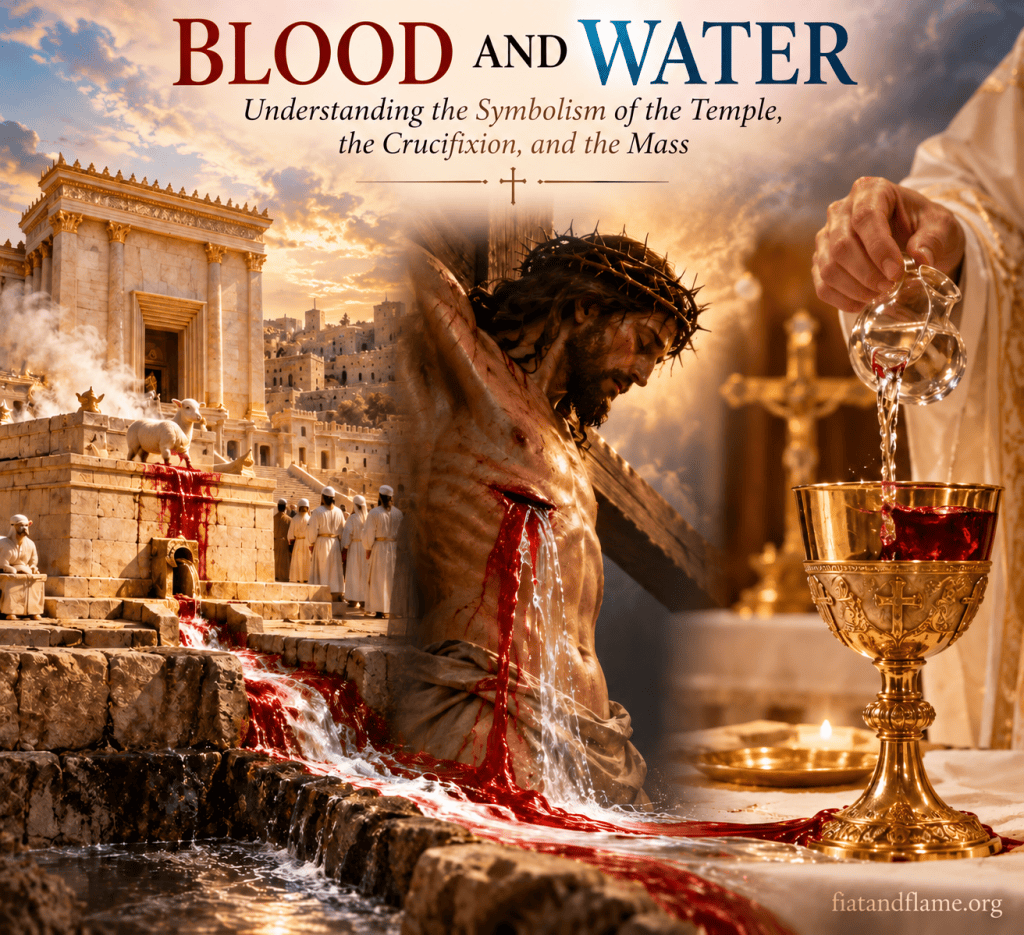
The Mishnah, a collection of Jewish traditions compiled around AD 200 that preserves descriptions of earlier Temple practices, explains that the altar had openings through which sacrificial blood drained into a water channel and flowed toward the Kidron Valley (Mishnah Middot 3:2). Another passage describes sacrificial blood mixing with water used to rinse the Temple area (Mishnah Yoma 5:6).
Catholic biblical scholar Dr. Brant Pitre draws attention to this practice in his book The Case for Jesus. He invites readers to consider what the Temple Mount might have looked like during Passover, when the blood of sacrifices entered the drainage system and mingled with water flowing away from the sanctuary.
Imagine the significance of that image to someone familiar with Temple worship: blood and water flowing from the place where sacrifices were offered to God.
Now consider what John tells us happened at the Crucifixion.
Jesus Christ: The True Temple and the Perfect Sacrifice
Earlier in his Gospel, John records a remarkable exchange between Jesus and the religious authorities in Jerusalem.
After Jesus cleansed the Temple, he declared that if the Temple were destroyed, he would raise it again in three days. His listeners misunderstood him, believing that he was referring to the great building that had taken decades to construct.
John clarifies his meaning:
“But he was speaking about the temple of his body.” — John 2:21
This statement changes how we understand the Crucifixion.
Jesus was identifying himself as the true dwelling place of God among humanity. The Temple in Jerusalem had represented God’s presence among his people, but in Jesus Christ, God had come to dwell among us personally. As John announces at the beginning of his Gospel, the eternal Word became flesh and made his dwelling among us (John 1:14).
Jesus was not merely another teacher who visited the Temple. He was the incarnate Son of God, the fulfillment toward which the Temple and its worship pointed.
And this true Temple would be destroyed through his death and raised again through his Resurrection.
When we return to John 19:34 with this understanding, the parallel becomes striking. Just as sacrificial blood mingled with water and flowed from the Jerusalem Temple, blood and water flowed from the pierced body of Jesus, whom John had already identified as the true Temple.
Pitre proposes that this historical background helps explain why John emphasizes the blood and water so carefully.
We should distinguish this interpretation from an explicit statement of Scripture. John does not directly tell us that the blood and water symbolize the Temple’s drainage system, nor does the Church require Catholics to accept this particular explanation. Nevertheless, it is a compelling biblical connection supported by what we know of ancient Temple worship.
The connection becomes even richer when we remember that John also identifies Jesus as the Lamb of God.
At the beginning of Jesus’ public ministry, John the Baptist proclaimed him to be the Lamb of God who takes away the sin of the world (John 1:29).
At the Crucifixion, John draws attention to the fact that Jesus’ bones were not broken, recalling the instructions concerning the Passover lamb in Exodus 12:46. Jesus fulfills what the earlier sacrifices anticipated, offering himself for the salvation of humanity.
He is both the true Temple and the perfect sacrificial Lamb.
The place of sacrifice and the sacrifice itself come together in the person of Jesus Christ.
The Water That Brings Life
There is another Old Testament passage that deepens our understanding of this extraordinary moment.
In Ezekiel 47, the prophet describes a vision of water flowing from the Temple. What begins as a small stream gradually becomes a mighty river, bringing life and restoration wherever it goes.
The waters refresh barren places, sustain living creatures, and nourish trees whose fruit provides food and whose leaves bring healing. Ezekiel’s vision presents an image of God’s life-giving presence flowing outward from his sanctuary to renew creation.
Centuries later, Jesus spoke of living water and invited those who thirsted to come to him. John explains that Jesus was speaking of the Holy Spirit, whom believers would receive (John 7:37–39).
With these passages in mind, the water flowing from Christ’s pierced side takes on profound meaning. Jesus, the true Temple, becomes the source from which the life of grace flows into the world.
This is also how the Catholic Church understands the blood and water sacramentally.
The Catechism of the Catholic Church, paragraph 1225, teaches that the blood and water flowing from the pierced side of Christ prefigure Baptism and the Eucharist, the sacraments of new life.
Through Baptism, we are united with Christ in his death and Resurrection and brought into the life of grace. In the Eucharist, we are nourished by the Body and Blood of the same Lord who offered himself for our salvation.
The Church also sees in the pierced side of Jesus an image of her own birth. Just as Eve was formed from the side of Adam, the Church Fathers recognized the Church as coming forth from Christ’s side as he slept in death upon the Cross (CCC 766).
The blood and water therefore speak not only of Christ’s sacrifice, but also of the new life made possible through that sacrifice.
What appeared to be the end of Jesus’ earthly life was, through his saving death and Resurrection, the beginning of new life for humanity.
The Mass: Water and Wine United in the Chalice
With this biblical foundation, we can return to the small gesture that takes place at every Catholic Mass.
During the preparation of the gifts, the priest or deacon pours a little water into the wine. As he does so, he quietly prays that through the mystery of this mingling we may share in Christ’s divinity, just as Christ humbled himself to share in our humanity.
The prayer is brief, but its meaning reaches into the very heart of the Incarnation.
Jesus Christ is fully God and fully human. In becoming man, he did not cease to be divine, nor did he merely appear to possess a human nature. He truly entered our human condition, sharing our physical existence and accepting suffering and death, while remaining without sin.
He did this not simply to experience our humanity, but to redeem it and bring us into communion with God.
The prayer accompanying the mixing of water and wine expresses this astonishing exchange: the Son of God took on our humanity so that, through grace, we might participate in his divine life.
This is closely connected with 2 Peter 1:4, which speaks of becoming participants in the divine nature.
It does not mean that human beings become gods by nature or cease to be human. Rather, God’s grace transforms us, drawing us into communion with him and making us increasingly capable of loving as Christ loves.
The symbolism of the water and wine was recognized by the early Church.
In the third century, St. Cyprian of Carthage explained that the wine represents the Blood of Christ, while the water represents the faithful. When the two are mingled, they signify the union of Christ with his people.
Consider the beauty of that explanation.
We are represented by the water. Christ is represented by the wine.
The water is not offered separately, but is mingled with the wine, expressing our incorporation into Christ and our participation in his saving life.
St. Thomas Aquinas would later explain that the mingling of water and wine recalls Christ’s Passion and signifies the union of the faithful with him (Summa Theologiae, III, question 74, articles 6–7).
It is important to understand that the mingling takes place before the consecration. At this point, the chalice contains wine and a little water. Through the Eucharistic Prayer and the consecration, the wine becomes the Precious Blood of Christ, while retaining the appearances of wine.
The water and wine are therefore not a literal recreation of the blood and water that flowed from Jesus’ side. They are a liturgical sign pointing to his Passion, his Incarnation, and our union with him.
And this brings us to the extraordinary relationship between Calvary and the Mass.
One Sacrifice, Made Present
The Mass is not a new sacrifice that replaces the Cross, nor is Christ sacrificed again each time the Eucharist is celebrated.
Catholic teaching is clear that Jesus offered himself once for all. His sacrifice is complete and sufficient.
The Eucharist makes that one sacrifice sacramentally present, allowing the Church to participate in its saving power throughout the ages.
As the Catechism explains in paragraphs 1366–1367, the sacrifice of Christ and the sacrifice of the Eucharist are one single sacrifice. The same Christ who offered himself upon the Cross is present and offered sacramentally in the Mass, although the manner of offering is different.
This helps us understand why the altar holds such a central place in Catholic worship.
At the Jerusalem Temple, the people brought their sacrifices before God. At Calvary, Jesus offered himself as the perfect sacrifice. At Mass, the Church participates in that same saving offering through the Eucharistic mystery.
The continuity is remarkable, but the difference is even more important.
The sacrifices of the Old Covenant anticipated what Christ would accomplish. His sacrifice fulfills them.
What once involved the blood of sacrificial animals now finds its fulfillment in the self-offering of the Son of God, whose blood establishes the New Covenant.
And the faithful are not merely spectators of this mystery.
The Church teaches that our own lives, prayers, labors, joys, and sufferings can be united with Christ’s offering (CCC 1368). We bring ourselves to the altar, not because our sacrifices possess saving power independent of Christ, but because he graciously allows us to participate in his perfect offering to the Father.
This is what makes the symbolism of the few drops of water so personally significant.
We are invited to bring our humanity into communion with Christ.
Our weaknesses do not exclude us from that invitation. Neither do our limitations, our failures, or the ordinary difficulties of daily life. Rather, these are precisely the circumstances in which we most need his grace.
The same Lord who entered our human condition invites us to place our lives into his hands, trusting that his grace can transform what we offer.
Recognizing the Mystery in a Simple Gesture
The next time we attend Mass, we might pay particular attention when the water is added to the wine.
Although we may not hear the priest’s quiet prayer, we can unite ourselves to its meaning.
We can remember the ancient Temple in Jerusalem, where sacrificial blood mingled with water. We can remember Jesus, the true Temple and Lamb of God, whose pierced side became a sign of the life poured out for our salvation. We can remember the waters of Baptism through which we entered into Christ’s life, and the Eucharist through which he continues to nourish us.
And perhaps most importantly, we can recognize ourselves in those few drops of water.
The gesture reminds us that Christian life is not simply a matter of admiring Jesus, remembering his teachings, or attempting to imitate his virtues through human effort alone. It is a life of communion with him, sustained by the grace that makes genuine transformation possible.
Human discipline can help us develop good habits, practice virtue, and become more attentive to the needs of others. Yet our deepest transformation comes through God’s grace, which works within us and enables us to grow in holiness.
The purpose of that transformation is love: deeper love for God, greater charity toward our neighbor, and a more faithful response to the vocation entrusted to each of us.
This is the invitation contained in the priest’s prayer. Christ entered our humanity so that we might share in his divine life.
What a different experience of the Mass we might have if we carried that understanding with us.
A small gesture that lasts only a few seconds becomes an opportunity to contemplate the whole history of salvation, from the sacrifices of the Old Covenant to the Cross of Christ and the sacramental life of the Church.
The blood and water flowing from Jesus’ side were not merely details of his death. They reveal the mystery of a love that gives itself completely and becomes the source of new life.
And the water mingled with wine reminds us that this love is not distant from us. We are invited to receive it, participate in it, and allow it to transform the way we live.
The true Temple is Christ himself. The perfect sacrifice is his own life. And through the Eucharist, we are invited into communion with the One who gave everything to bring us to the Father.
Sources and Further Reading
Sacred Scripture
- John 1:14, 29; 2:19–21; 7:37–39; 19:31–37 — Jesus as the Lamb of God, the true Temple, and the source of living water.
- Exodus 12:1–14, 21–27, 46 — The Passover lamb and the deliverance of Israel.
- Leviticus 17:11 — The significance of blood in sacrificial worship.
- Ezekiel 47:1–12 — The life-giving waters flowing from the Temple.
- 2 Peter 1:4 — Participation in the divine nature.
- Hebrews 9:11–14; 10:10–14 — Christ’s once-for-all sacrifice.
Catholic Teaching and Early Christian Writings
- Catechism of the Catholic Church, §§ 766, 1225, 1366–1368 — The Church born from Christ’s side, the sacraments of new life, and the Eucharistic sacrifice.
- General Instruction of the Roman Missal, §§ 72, 142, 178 — The preparation of the gifts and the mixing of water and wine.
- St. Cyprian of Carthage, Letter 63, especially § 13 — The union of Christ and his people symbolized by water and wine.
- St. Thomas Aquinas, Summa Theologiae, III, q. 74, articles 6–7 — The symbolism of water mixed with Eucharistic wine.
Historical and Biblical Scholarship
- Brant Pitre, The Case for Jesus: The Biblical and Historical Evidence for Christ (Image, 2016) — Jesus as the true Temple and the significance of blood and water at the Crucifixion.
- Mishnah Middot 3:2 and Mishnah Yoma 5:6 — Ancient Jewish descriptions of sacrificial blood draining from the Temple altar and mingling with water.
The Temple drainage parallel discussed by Pitre is a historical and theological interpretation. It complements the Church’s established sacramental understanding of John 19:34 without being a required doctrine of Catholic faith.
Fiat & Flame Ministries


Leave a Reply