
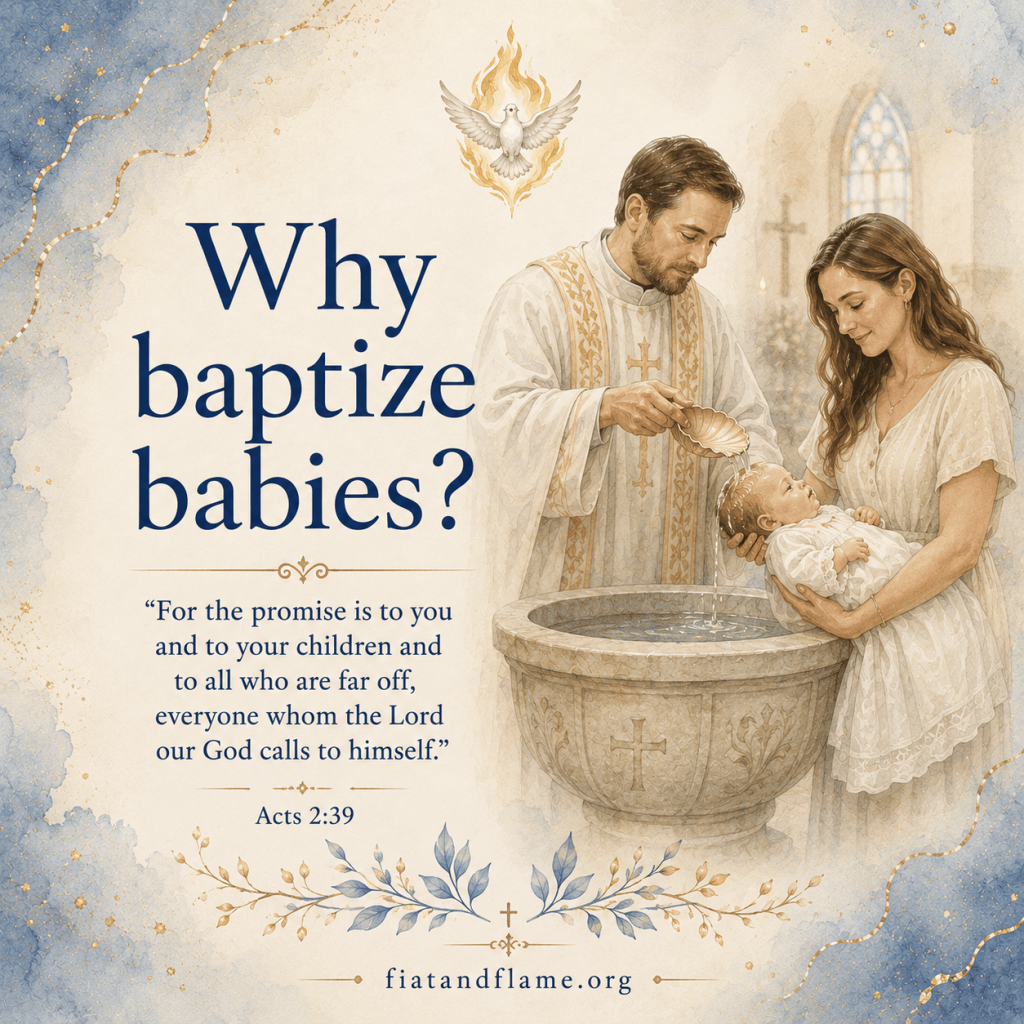
Infant baptism can be confusing, especially for Christians who grew up hearing that baptism should only happen after someone is old enough to personally believe, repent, and choose to follow Jesus.
The most common question is simple: How can a baby be baptized if a baby cannot understand what is happening?
A lot depends on what baptism is understood to be.
If baptism is mainly a public symbol of a person’s decision to follow Christ, then infant baptism can seem difficult to justify. Catholic teaching, however, understands baptism as something more than a symbol. It is a sacrament through which God gives grace, washes away original sin, brings a person into the life of Christ, and incorporates that person into His Church.
That changes the focus. The question is no longer only whether the person being baptized is old enough to explain what is happening, but whether God can give grace before a person fully understands it.
But babies cannot believe or choose for themselves
That is true. A baby cannot make a personal profession of faith or decide for himself that he wants to be baptized.
But parents make important decisions for children long before children are old enough to decide for themselves. They choose medical care, education, and how their children will be raised. They teach right from wrong and shape a child’s understanding of family, responsibility, and the world around them.
Parents also give children things that are good long before those children understand their value. A baby receives love before understanding love. A child may receive an inheritance before being old enough to understand what has been given.
Catholics see baptism in a similar way.
If baptism truly gives grace, then giving that grace to a child is not taking away freedom. It is giving the child something good before the child is old enough to ask for it.
The parents and godparents profess the faith and accept the responsibility of raising the child in that faith. Later, the child must personally embrace what was given. Infant baptism does not remove the need for personal faith or conversion. It begins a life that must eventually be lived freely and consciously.
What about repentance?
Acts 2:38 says:
“Repent and be baptized.”
That verse is often used as an objection to infant baptism because babies cannot repent.
But Peter was speaking to adults who had just heard the Gospel. Of course adults are called to repent and believe. The Church still requires that of adult converts today.
The question is whether the same requirement must be applied in exactly the same way to infants.
Scripture never says that children must wait until a certain age before being brought into the covenant. In fact, the biblical pattern gives good reason to think otherwise.
Children were included in God’s covenant
Under the Old Covenant, infant boys were circumcised at eight days old.
They did not understand the covenant, and they did not personally choose it. Their parents brought them into it.
St. Paul later connects circumcision and baptism in Colossians 2:11–12.
That raises an important question. If children were included in God’s covenant before Christ, why would the New Covenant exclude them until they were old enough to reason for themselves?
The New Covenant is greater, not narrower.
What about household baptisms?
The New Testament records several entire households being baptized.
Lydia and her household were baptized in Acts 16:15. The Philippian jailer and his household were baptized in Acts 16:33. Paul also mentions baptizing the household of Stephanas in 1 Corinthians 1:16.
The Bible does not specifically say that infants were present in those households, so these passages do not prove infant baptism by themselves.
But they do fit with the biblical pattern of households and families being brought into covenant life together. Faith in Scripture is deeply personal, but it is not always treated as something isolated from family and community.
Jesus welcomed children
Jesus said:
“Let the children come to me, and do not hinder them.”
— Matthew 19:14
This verse is not a direct command to baptize infants, but it does show something important. Children are not outside the concern of Christ because they are too young to understand theology. They are welcomed into His presence.
“Baptism is only a symbol”
This is really where much of the disagreement comes from.
If baptism is only a symbolic testimony of a person’s decision to follow Jesus, then infant baptism makes little sense.
But the New Testament speaks about baptism in stronger terms.
Jesus speaks of being “born of water and the Spirit” in John 3:5.
Peter says:
“Baptism… now saves you.”
— 1 Peter 3:21
Paul says that Christians are buried with Christ in baptism in Romans 6, and Titus 3:5 speaks of the “washing of regeneration.”
Those passages are why Catholic teaching understands baptism as more than a public symbol. Something is actually being given.
And if God is acting in baptism, then the question becomes whether He must wait until a person is old enough to understand everything before He can act.
Catholic teaching says no.
“But Jesus was baptized as an adult”
Jesus was baptized as an adult, but He received the baptism of John.
John’s baptism was a baptism of repentance that prepared Israel for the coming Messiah.
Christian baptism in the name of the Father, Son, and Holy Spirit was instituted later.
After His resurrection, Jesus said:
“Go therefore and make disciples of all nations, baptizing them in the name of the Father and of the Son and of the Holy Spirit.”
— Matthew 28:19
So Jesus’ age at His baptism does not establish a minimum age for Christian baptism.
“Babies have not sinned”
Catholics agree that babies have not committed personal sins.
Original sin does not mean that a newborn baby is personally guilty of wrongdoing. It means that humanity is born into a fallen condition and deprived of the original holiness and communion with God that humanity was created to have.
Romans 5 connects sin and death with the fall of Adam.
Baptism brings the new life of Christ.
So Catholics do not baptize babies because they believe babies are personally wicked. They baptize them because every human being needs grace.
The early Church baptized infants
Infant baptism is not a medieval invention.
By the second and third centuries, there is clear evidence that Christians were baptizing infants. Hippolytus gave instructions for baptizing children, with parents or relatives answering for those too young to speak. Origen wrote that the Church had received the practice of baptizing infants from the apostles.
There were early discussions about when baptism should take place, but infant baptism itself appears very early in Christian history.
That matters because it shows that this was not a practice added many centuries later. It was already present in the life of the early Church.
The deeper question
At the heart of infant baptism is a simple question: Does God have to wait until a person fully understands His grace before He can give it?
Catholic teaching says no.
Throughout Scripture, God is the One who takes the initiative. His grace is not something we earn by first reaching a certain level of understanding, maturity, or spiritual knowledge. Baptism reflects that same pattern: God gives, and over time the person grows into a fuller understanding of what has been received.
A baby brings no theological knowledge, no good works, and no ability to explain faith. Yet that does not place the child beyond the reach of grace.
That may be one of the clearest ways to understand infant baptism: the Christian life begins with a gift, and understanding that gift comes later.


Leave a Reply