
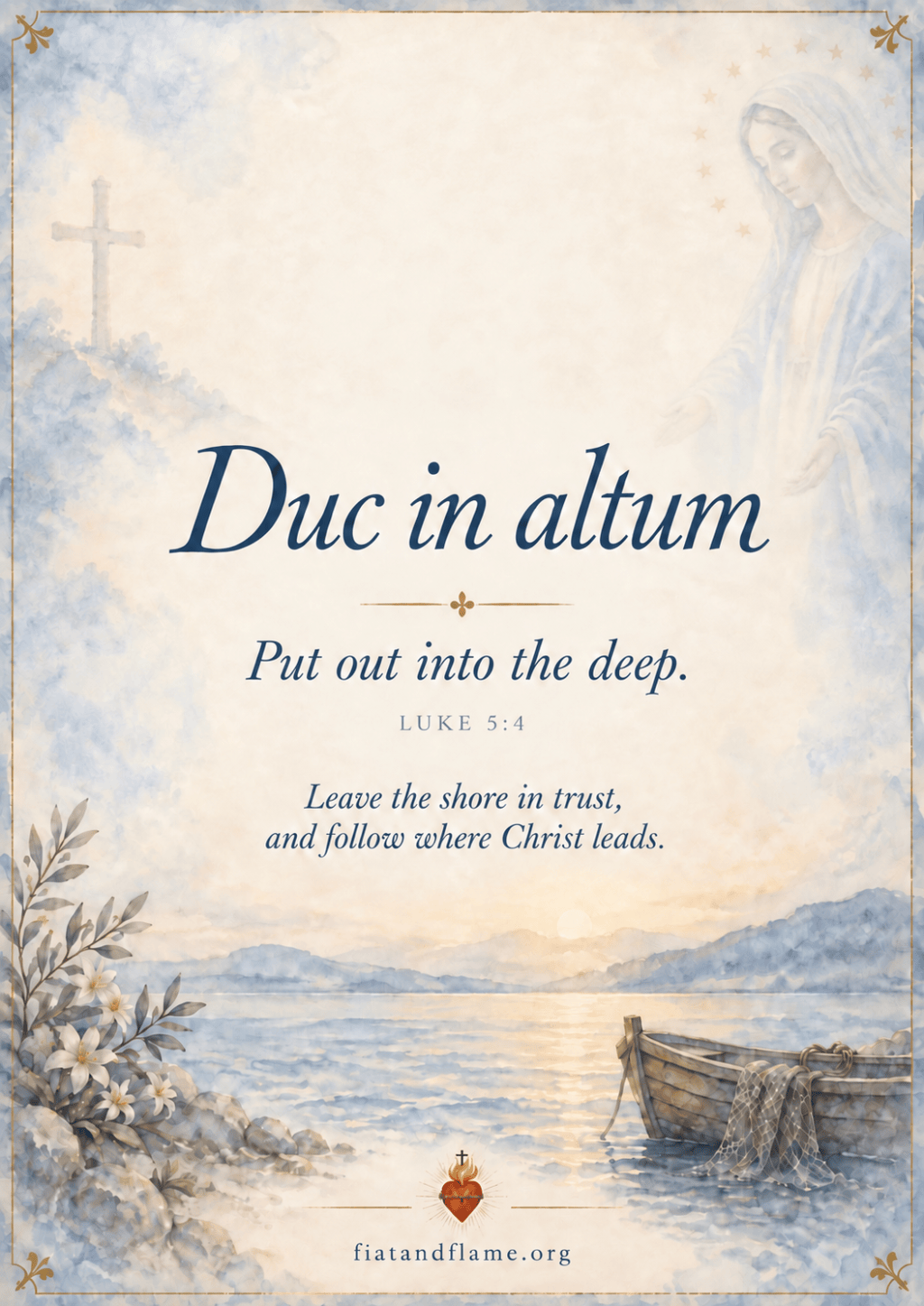
“Put out into the deep.” — Luke 5:4
There are moments when faith feels less like standing securely on shore and more like being asked to push a boat into water where we can no longer touch bottom.
That is the setting for Jesus’ words to Simon Peter in Luke 5.
Peter and the other fishermen had worked through the night and caught nothing. They were experienced fishermen. They knew the lake. They knew their trade. By every reasonable calculation, another attempt was unlikely to accomplish anything.
Yet Jesus told Peter:
“Put out into the deep and let down your nets for a catch.” — Luke 5:4
Peter obeyed, and the result was an overwhelming catch of fish.
The Latin expression Duc in altum is commonly translated “Put out into the deep.” It became one of the defining spiritual phrases of the later pontificate of Pope St. John Paul II.
JOHN PAUL II AND DUC IN ALTUM
At the conclusion of the Great Jubilee of the Year 2000, John Paul II wrote his apostolic letter Novo Millennio Ineunte, At the Beginning of the New Millennium. He opened the document with this Gospel scene.
The Church had just celebrated two thousand years since the birth of Christ. It would have been natural simply to look backward at everything that had already been accomplished.
Instead, John Paul II pointed toward the water.
He wrote that Christ’s words to Peter should continue to resound in the Church: “Duc in altum!” He described them as an invitation to remember the past with gratitude, live the present with enthusiasm, and face the future with confidence in Christ.
For John Paul II, this was not merely a call for the Church to become busier or to launch more programs.
He later explained that putting out into the deep meant becoming both more missionary and more contemplative. The Church had to go outward into the world, but she could do so only by first going more deeply into Christ.
That distinction matters.
Christian depth is not constant activity. It is not recklessness, ambition, or chasing novelty.
It is a willingness to go where Christ directs, even when His direction carries us beyond what feels predictable or controllable.
THE SHORE IS COMFORTABLE
The shore represents what we know.
It is the familiar job, the established routine, the relationship pattern we understand, the ministry we already know how to perform, the level of prayer that asks little of us, or the version of ourselves we have become accustomed to being.
None of those things is necessarily bad.
But sometimes Christ begins calling us farther.
The difficult part is that deeper water often removes the things we normally use to reassure ourselves.
We may not know exactly how something will work.
We may not feel qualified.
We may have tried something before and failed.
We may be tired.
Peter had an especially good reason to resist Jesus: he had already tried.
“We have worked all night and have caught nothing,” he tells Him.
Then comes one of the most important responses of discipleship:
“But at Your word…”
Peter did not obey because the circumstances had suddenly become more favorable. He obeyed because Christ had spoken.
WHAT DOES DUC IN ALTUM LOOK LIKE TODAY?
Most of us will never be asked to leave fishing boats on the Sea of Galilee. But the invitation into deeper water appears constantly in ordinary Christian life.
It may look like taking faith more seriously instead of keeping Catholicism confined to Sunday Mass—finally studying Scripture, learning what the Church teaches, receiving the sacraments more intentionally, or developing a real life of prayer.
It may mean responding to a vocation or ministry that keeps returning to your heart even though you feel unprepared.
It may mean having the conversation you have been avoiding because reconciliation requires vulnerability.
It may mean serving someone inconvenient, particularly when compassion costs time rather than merely good intentions.
It may mean speaking openly about faith in a culture where remaining silent would be easier.
It may mean starting over after failure when experience tells you that nothing will change.
It may even mean remaining faithful in something very ordinary when there is no dramatic sign that your effort is accomplishing anything.
That is Duc in altum.
DEEPER DOES NOT MEAN RECKLESS
There is an important distinction here.
Not every difficult idea is a calling from God, and not every frightening decision represents “going into the deep.”
Christian discernment still matters.
Scripture, prayer, the teachings of the Church, wise counsel, our responsibilities, and the circumstances of our lives all help us discern whether something truly comes from God.
But once that discernment becomes reasonably clear, there comes a point when further analysis can become another form of staying on shore.
We can spend years asking God for certainty when what He is asking for is trust.
Peter did not receive a detailed explanation of why another attempt would succeed.
He received a command.
And then he moved the boat.
THE DEEP IS WHERE DEPENDENCE BEGINS
Perhaps that is why Christ sometimes leads us beyond familiar waters.
In the shallows, we can still imagine that we are sustaining ourselves.
In deeper water, our limitations become obvious.
Our competence has limits.
Our plans have limits.
Our understanding has limits.
Our strength has limits.
But Christ does not.
This is one reason John Paul II connected Duc in altum so closely with hope. The Christian can move forward confidently not because the future is predictable, but because Christ remains faithful within an unpredictable future.
That is very different from optimism.
Optimism says, “I think things will work out.”
Faith says, “I know Who is in the boat.”
LEAVE THE SHORE
There may be an area of life right now where the shore feels particularly comfortable.
Perhaps there is also something farther out that Christ has been quietly placing before you.
A deeper prayer life. A difficult act of obedience. A work of service. A vocation. A needed change. A truth that must finally be faced. A dream that must be surrendered—or one that must finally be pursued.
The question is not whether the deeper water looks safe.
Peter’s certainly did not.
The question is whether Christ is calling us there.
If He is, the response of Peter can become our own:
“At Your word, I will let down the nets.”
And then we push away from shore.
Duc in altum.
Put out into the deep.
Leave the shore in trust, and follow where Christ leads.


Leave a Reply