
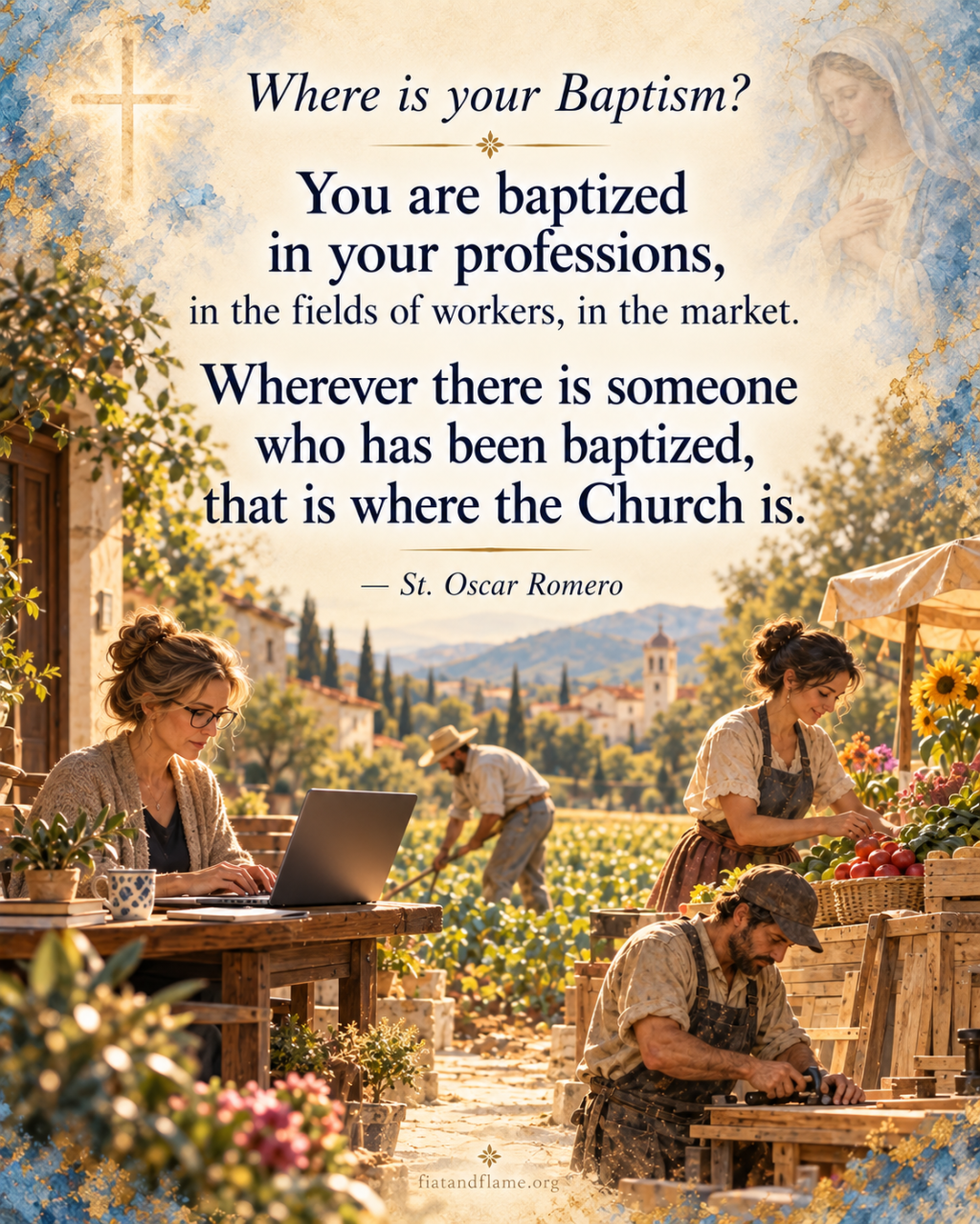
“Where is your Baptism? You are baptized in your professions, in the fields of workers, in the market. Wherever there is someone who has been baptized, that is where the Church is.”
— St. Óscar Romero
When we think about living out our Catholic faith, we often think of attending Mass, receiving the sacraments, praying, volunteering at our parish, or participating in a ministry. These are essential parts of our spiritual lives, but St. Óscar Romero reminds us that our baptismal calling extends far beyond the walls of our churches.
It follows us into our workplaces, our homes, our neighborhoods, and every ordinary activity that makes up our days.
The question is whether we recognize it.
Baptism Is an Identity, Not Just an Event
For many of us, baptism happened before we were old enough to remember it. We may have photographs of the occasion, a baptismal candle tucked away somewhere, or a certificate documenting the day we became members of the Church.
But baptism isn’t simply something that happened to us years ago. It is something that fundamentally changed who we are.
Through baptism, we become members of the Body of Christ, children of God, and participants in the mission of His Church. We receive a calling that accompanies us throughout our lives, regardless of our occupations, responsibilities, or circumstances.
The Catechism of the Catholic Church teaches that baptism gives us a share in Christ’s priestly, prophetic, and royal mission (CCC 1268). This participation is not reserved for priests, religious sisters, missionaries, or those employed by the Church. It belongs to every baptized Christian.
And that means our ordinary lives carry extraordinary possibilities.
The Church Is Present in the Ordinary
Consider the people St. Óscar Romero mentions: workers in the fields, professionals, and people going about their business in the marketplace.
We could easily expand that list to include accountants, construction workers, teachers, retail employees, mechanics, office workers, business owners, and parents caring for their children.
What do all these people have in common?
Each has opportunities to make Christ present in places where others may never encounter Him otherwise.
Think about someone sitting at a computer for eight hours a day. Their work may seem completely unrelated to their faith. There may be no religious conversations, no visible acts of charity, and certainly no opportunity to stop everything and pray whenever they wish.
Yet their baptismal calling is present in how they conduct themselves. It is expressed through their honesty, their patience with difficult colleagues, their willingness to help someone who is struggling, and the care they take in doing their work well.
Consider a tradesperson whose craftsmanship reflects integrity and whose treatment of customers demonstrates respect. Or a business owner who pays fair wages, refuses to exploit vulnerable people, and treats employees as human beings rather than merely as a means of increasing profits.
These are opportunities to live out the Gospel in very practical ways.
Our professions do not have to be explicitly religious to become expressions of our Christian vocation.
The Universal Call to Holiness
The Second Vatican Council emphasized something that is especially relevant to Romero’s words: every Christian is called to holiness.
In Lumen Gentium, the Council explains that all the faithful, whatever their state or condition, are called to the fullness of Christian life and the perfection of charity (LG 40).
Holiness is not limited to the monastery, the sanctuary, or the mission field.
It is just as relevant to the woman answering customer complaints, the father working overtime to provide for his family, the farmer tending his crops, or the caregiver whose days are consumed with meeting someone else’s needs.
This doesn’t mean that simply going to work or completing our daily responsibilities automatically makes us holy. Rather, these responsibilities provide opportunities to practice the virtues that form us in holiness.
Patience when we are frustrated. Justice when we make decisions that affect others. Temperance when our emotions threaten to control our responses. Courage when doing what is right comes at a personal cost.
The circumstances of our ordinary lives become opportunities to grow in virtue and love.
Bringing Christ Into Places That Need Him
There is another dimension to Romero’s words that deserves our attention.
When he speaks about the Church being present wherever there is a baptized person, he is reminding us that the Church is a living community of people, not simply a building or an institution.
Romero understood this in the context of El Salvador, where he witnessed poverty, exploitation, and violence. He emphasized the Church’s responsibility to stand with those who suffered and to defend human dignity.
His understanding of Christian witness was deeply practical.
Our baptismal identity has consequences for the way we treat people, particularly those who have little influence, recognition, or power.
Perhaps we work somewhere that encourages dishonesty or treats employees unfairly. Perhaps we encounter people whose dignity is routinely overlooked. Maybe our opportunities are less dramatic: a difficult customer, a lonely neighbor, or a colleague who is quietly struggling.
In each of these situations, we have an opportunity to respond as members of Christ’s Body.
Sometimes that response requires courage. Sometimes it requires speaking up. Often it is expressed through small, consistent acts of compassion that nobody else notices.
Our witness is not measured by how frequently we mention our faith. It is also revealed in how faithfully we live it.
Mary’s Fiat and Our Daily Yes
Mary offers a beautiful example of what it means to carry God’s presence into ordinary life.
At the Annunciation, she responded to God’s invitation with her fiat:
“Behold, I am the handmaid of the Lord. May it be done to me according to your word.” (Luke 1:38)
Her yes changed the course of human history, yet much of her life afterward unfolded within the ordinary responsibilities of family and community.
She cared for her home, raised Jesus alongside Joseph, participated in the religious life of her community, and experienced the joys and difficulties of human relationships.
Her extraordinary vocation was lived, in large part, through ordinary faithfulness.
Our own fiat may not involve a dramatic moment or a remarkable mission. It may be expressed through the work waiting on our desks, the people who depend on us, or the responsibilities we would occasionally rather avoid.
Each morning presents another opportunity to offer our lives to God and to ask how we might serve Him through whatever the day requires.
When we approach our responsibilities with that intention, even the most routine activities can become opportunities to cooperate with His grace.
Where Is Your Baptism Today?
St. Óscar Romero’s question invites us to examine how we understand our place in the Church.
It is easy to separate our spiritual lives from our everyday responsibilities, as though we spend a few hours each week being Catholic and the remainder simply going about our business.
But our baptism doesn’t recognize those boundaries.
We remain members of Christ’s Body when we leave Mass on Sunday morning, when we clock in on Monday, when we sit down to pay the bills, and when we care for someone who needs us.
Our faith should influence how we conduct our business, handle conflict, use our resources, and treat people who can offer us nothing in return.
And perhaps this is where Romero’s question becomes particularly meaningful.
We don’t have to search for some extraordinary opportunity to serve God while overlooking the opportunities He has already placed before us.
The people we encounter today are our neighbors. Our responsibilities are opportunities to practice virtue. Our workplaces and homes are places where we can bear witness to Christ.
The Church gathers to worship, receive the sacraments, and be strengthened by God’s grace. Then its members go out into the world to live the faith they profess.
Wherever our lives take us, our baptism goes with us.
And wherever we go, we have an opportunity to make Christ’s love visible.
Fiat & Flame Ministries
Devotion • Formation • Charity
fiatandflame.org


Leave a Reply