The moon has long been connected with Mary in Christian imagination, and it is easy to see why. Its beauty is quiet rather than overpowering. It does not create its own light; it receives light from the sun and reflects it into the darkness. That makes it a fitting image for Mary, whose whole life was oriented toward receiving from God and reflecting Him to the world.
Mary is never the source of grace or glory. Christ is. What makes her luminous is precisely that she receives from Him so completely.
Her own words in the Magnificat capture this beautifully: “My soul magnifies the Lord” (Luke 1:46). She does not point to herself. She magnifies God. Her life makes His goodness more visible.
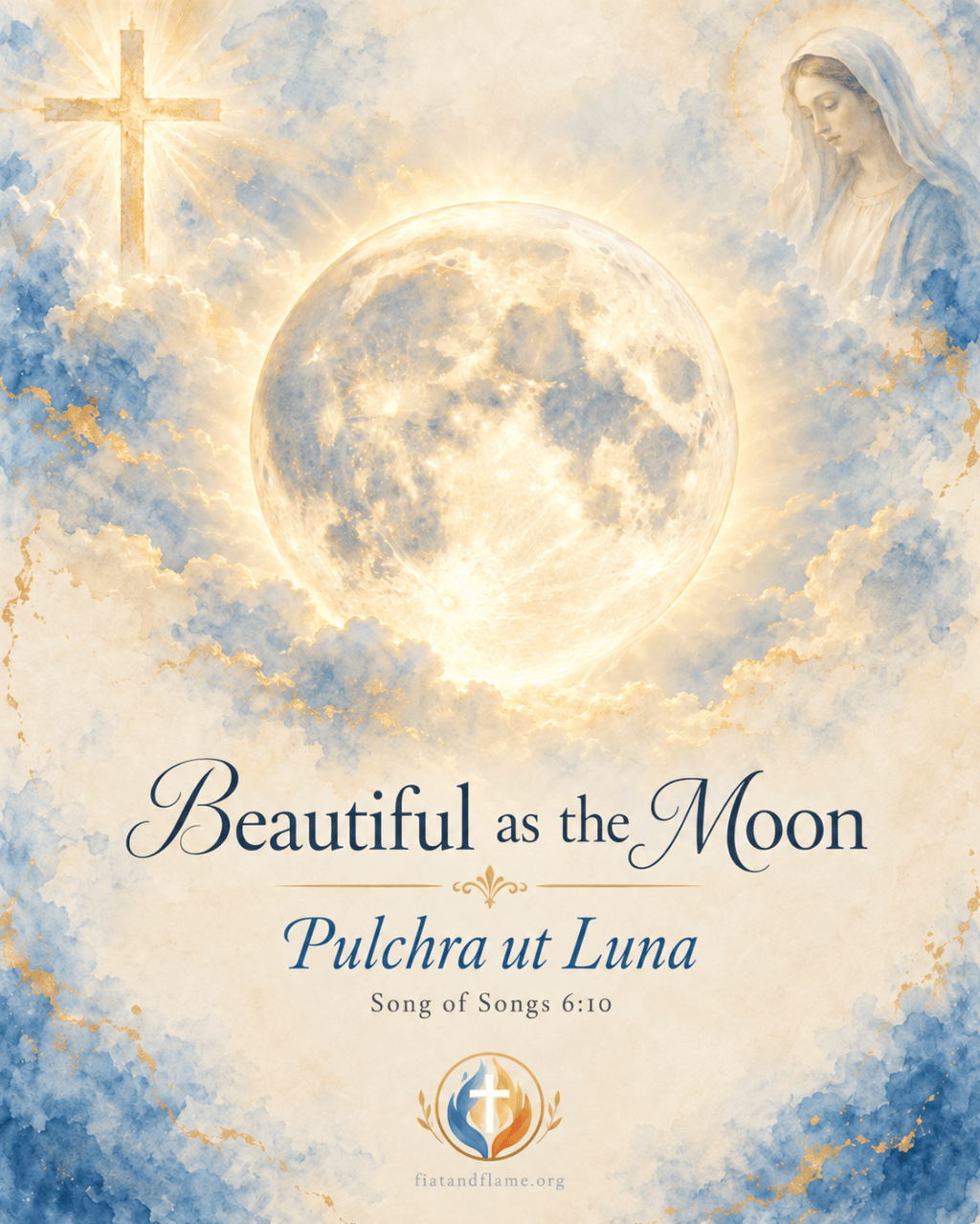
This is one reason the old Marian phrase Pulchra ut luna—“beautiful as the moon”—is so striking.
The phrase comes from Song of Songs 6:10: “Who is this that looks forth like the dawn, beautiful as the moon, bright as the sun?” The Song of Songs was not written as a direct prophecy about Mary, but Christians have long read its imagery spiritually, applying its language both to the Church and, in a particular way, to the Blessed Virgin.
The moon becomes especially meaningful when we think about reflected light. A full moon can illuminate the night so brightly that it almost seems to shine by its own power, but every bit of that light is received. Its beauty comes from remaining turned toward the sun.
Mary does something similar in the spiritual life. She receives the grace of God and responds with her Fiat: “Let it be done to me according to your word” (Luke 1:38). She does not try to create holiness on her own terms. She receives, trusts, and cooperates.
That is part of what makes Marian devotion so deeply Christ-centered. Mary’s role is never to replace Christ, compete with Him, or draw attention away from Him. Her entire life directs us toward Him.
At Cana, she says simply, “Do whatever He tells you” (John 2:5). That sentence could almost serve as a summary of Mary’s role in the life of the Church. She receives Christ, brings Christ into the world, and then points others back to Him.
The moon also offers another beautiful spiritual image because it shines in darkness. It does not make the night disappear. It simply carries light into it.
That is close to the Christian vocation itself. We are not called to become the source of light. We are called to receive the Light of Christ so deeply that His presence becomes visible through us.
Jesus says, “You are the light of the world” (Matthew 5:14), but the Christian understanding of that light is always dependent on Him. We shine because we belong to Christ.
Mary shows what that receptivity can look like when it is lived fully. Her holiness is not self-glorification. It is a life so open to God that His grace becomes visible through her.
That is why the moon can be such a fitting Marian symbol. Its beauty is received beauty. Its light is reflected light. Its brilliance points beyond itself to its source.
And that is the pattern Mary gives us.
To remain turned toward Christ.
To receive what He gives.
To trust His light even in darkness.
And then to reflect that light into the world.
Beautiful as the moon.
Pulchra ut luna.
Marian Reflection
Where might God be inviting you to become more receptive to His grace, so that His light can be reflected more clearly through your life?


Leave a Reply