The Communion of Saints is one of the most beautiful teachings of the Catholic Church because it reminds us that the Christian life is never meant to be lived in isolation.
Catholics believe that everyone who belongs to Christ is united in one Body. That includes Christians who are still living on earth, the souls being purified for heaven, and the saints who are already with God. Death changes where a person is, but it does not remove that person from the Body of Christ.
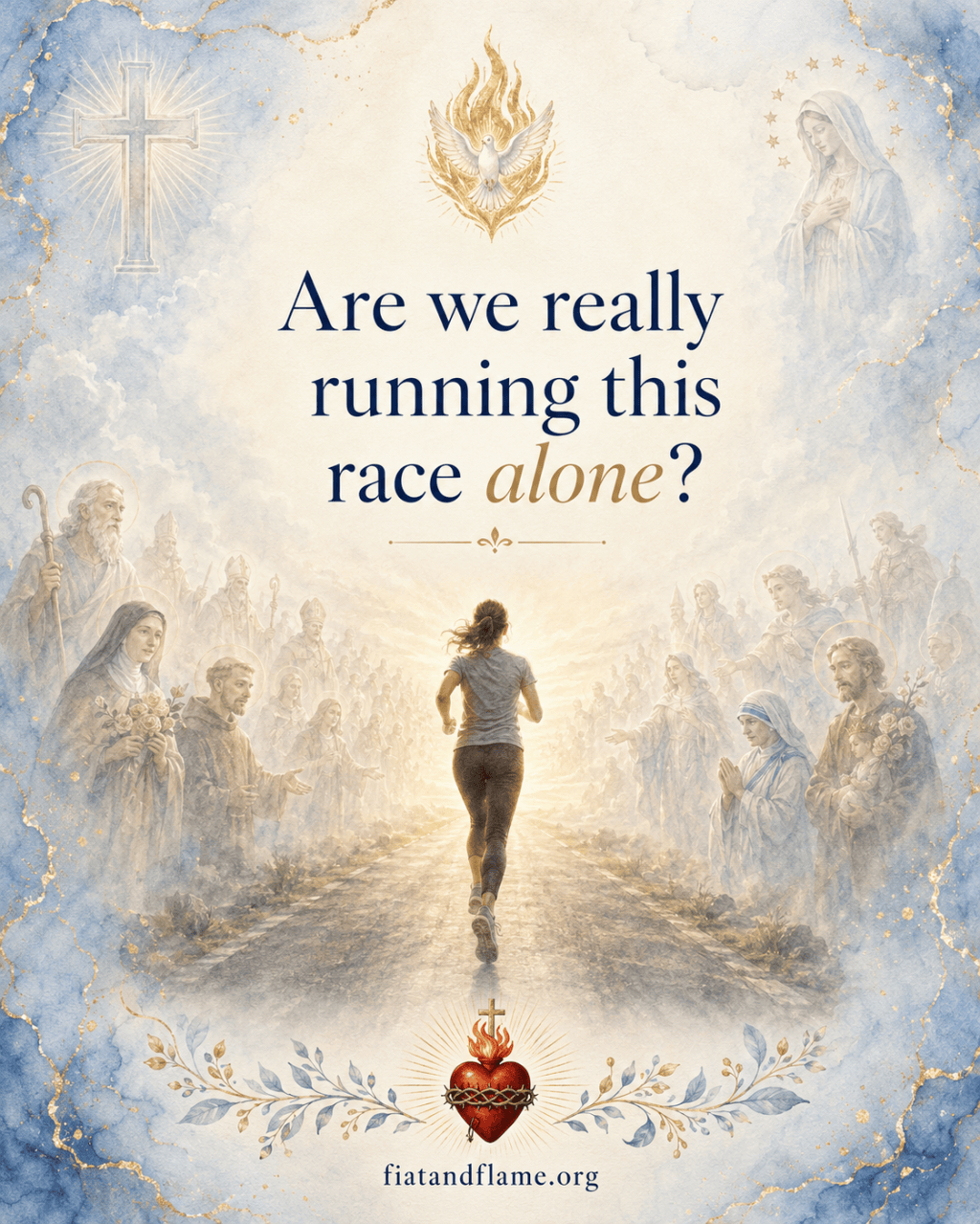
A modern way to understand this is to picture a long-distance race.
Imagine that you are running a difficult race. Some people are running beside you, encouraging you and helping you keep going. Others have already completed the course and now stand near the finish, watching those who are still making their way forward. They know the difficult stretches because they have already passed through them. They know what exhaustion feels like, and they know what it is like to wonder whether you have enough strength to continue.
Hebrews gives us a similar image when it describes Christians as being surrounded by a “great cloud of witnesses” as we run the race set before us (Hebrews 12:1).
The saints are those who have already finished that race.
They are not distant religious figures who simply belong to history. They are members of the same Body of Christ to which we belong, and the Church teaches that they continue to care for and pray for those of us who are still on the journey.
This becomes especially meaningful when we consider the lives they lived.
St. Peter understood failure, regret, and beginning again. St. Monica knew what it was like to pray patiently for someone she loved. St. Joseph understood responsibility, work, uncertainty, and the weight of caring for a family. St. Thérèse knew how ordinary acts could become expressions of extraordinary love. Mary knew what it meant to trust God without knowing everything that would follow from her yes.
The saints faced fear, grief, temptation, uncertainty, disappointment, and suffering just as we do. Their holiness did not come from avoiding the difficulties of human life. It came from allowing God to work through those difficulties.
This is why Catholics ask the saints to pray for us.
We already ask other Christians for prayer. We may call a friend before surgery, ask our parish to pray for someone who is sick, or tell a family member that we are struggling and need prayer. Asking a saint to pray for us follows the same basic principle.
We are not replacing Jesus, and we are not suggesting that the saints have power apart from God. We are asking another member of Christ’s Body to pray with us and for us.
Jesus Himself said that God “is not God of the dead, but of the living” (Luke 20:38). Those who are with Christ are not gone in the ultimate sense. They are alive in Him.
The Book of Revelation even gives us a glimpse of heaven in which the prayers of the saints are presented before God like incense (Revelation 5:8).
The Communion of Saints therefore gives us something very practical in our lives today: companionship.
When we are discouraged, we can remember that Christians before us have faced similar struggles and remained faithful. When we need courage, we can look to the martyrs. When we need patience, we can look to those who endured years of difficulty. When we need hope, we can remember that the saints were ordinary human beings transformed by grace.
Statues, icons, feast days, and stories of the saints are not meant to turn our attention away from God. They are reminders of what God can accomplish in a human life.
They are a little like family photographs displayed throughout a home. We do not look at them because the people in the pictures are more important than the family itself. We look at them because they remind us who we belong to and where we come from.
The Communion of Saints tells us that our family in Christ is much larger than the people we happen to know personally.
It stretches across nations, centuries, cultures, and generations. Some members of that family are still running beside us, and others have already completed the race.
Because we belong to one Body in Christ, we do not have to imagine the Christian life as a solitary journey toward heaven. We walk with the Church, we pray for one another, and we receive the prayers of those who have gone before us.
The saints have already reached the finish, but they have not forgotten those who are still running.


Leave a Reply