
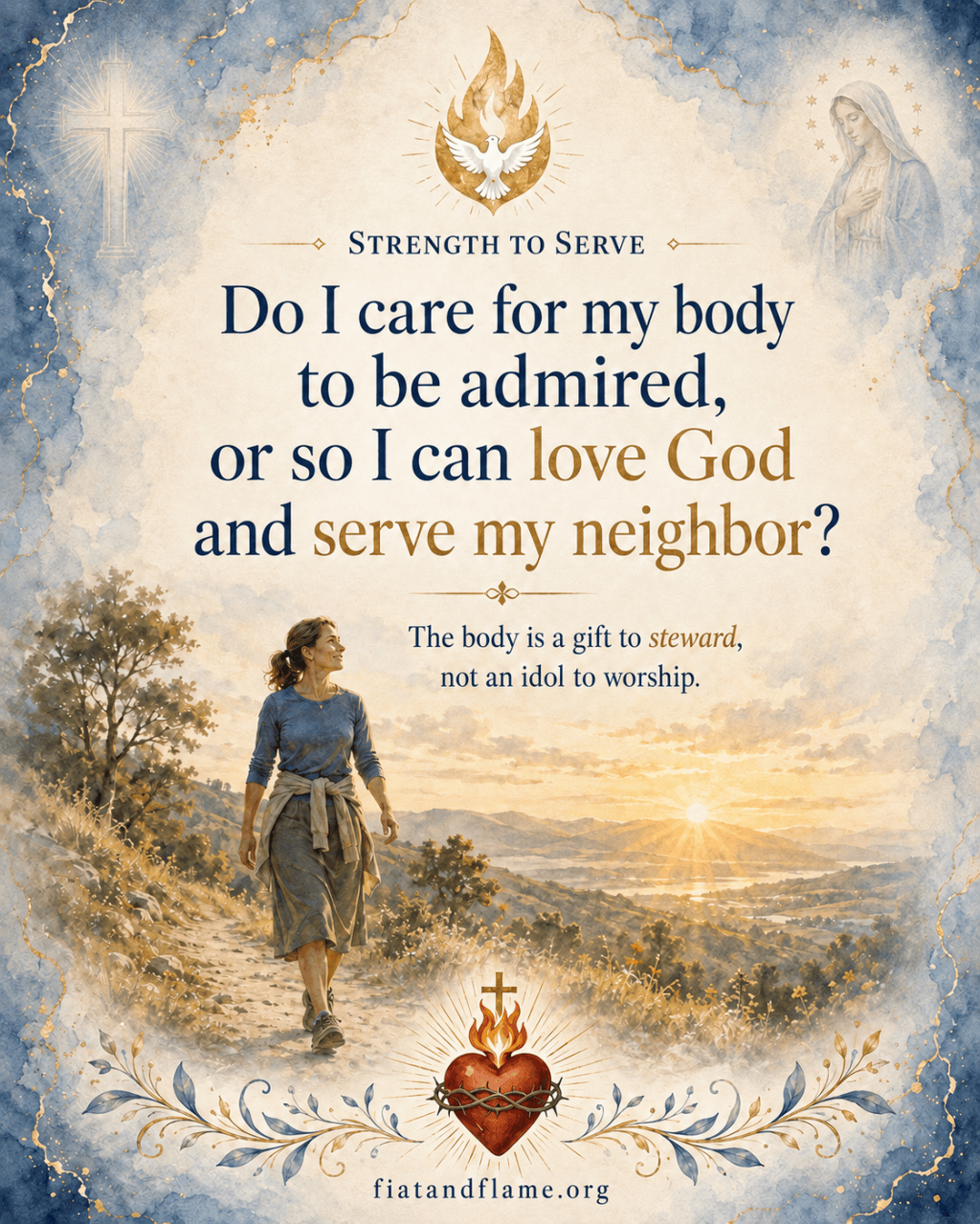
Fitness, Virtue, and Christian Stewardship
There is a passage in the books of Maccabees that feels surprisingly relevant to the way we think about fitness today.
During the period of intense Hellenization before the Maccabean revolt, some Jews began adopting Greek customs and built a gymnasium in Jerusalem. To modern ears, that may sound harmless. We hear the word gymnasium and think of exercise, health, strength, recreation, and perhaps a place where people are trying to take better care of themselves.
But the ancient Greek gymnasium represented much more than physical training.
It was part of a larger cultural system that included public nudity, athletic prestige, Greek identity, intellectual formation, civic life, and pagan customs. Some Jewish men even tried to conceal the physical sign of circumcision so they would appear more fully assimilated into Greek culture.
Second Maccabees describes the problem even more vividly. The attraction of Greek athletic culture became so strong that some priests neglected their duties at the altar in order to participate in the activities surrounding the gymnasium. The real issue was not physical strength or athletic ability. It was that devotion to the surrounding culture had begun to compete with covenant, worship, modesty, and fidelity to God.
That distinction matters today.
Christianity has never taught us to despise the body. We believe that God created the human person as body and soul, that Christ took on a real human body in the Incarnation, and that we are destined for the resurrection of the body. The Catechism teaches that physical health is a precious gift and that we have a responsibility to care for it reasonably.
At the same time, the Church warns against making bodily health or physical perfection into an absolute value. That warning is remarkably relevant in a culture where we can measure almost everything about ourselves, from calories and protein to steps, heart rate, sleep, body fat, strength, pace, recovery, and physical progress.
These tools can be useful, but they can also become sources of preoccupation. Caring for the body can gradually turn into fixation on the body, and discipline can quietly become pride if we begin to derive too much of our identity from how we eat, how we train, how we look, or what our bodies can do.
A Christian approach to fitness begins with stewardship.
The human body is an extraordinary part of God’s creation. Through it we experience the world He made, move through nature, work, worship, embrace the people we love, serve our neighbors, build, cook, garden, dance, rest, travel, and participate in relationships. Caring for the body can therefore be an act of gratitude for the gift of life rather than an act of vanity.
We do not care for the body because it is perfect or because our worth depends on its appearance. We care for it because it is a gift entrusted to us and because it allows us to participate in the life God has given us.
Christians can also fall into the opposite error. In an effort to focus on spiritual things, it is possible to treat physical health as though it does not matter very much. Exercise disappears, nutrition becomes an afterthought, sleep is neglected, and physical capacity is allowed to decline more than necessary.
But neglect is not humility.
The body is one of the primary means through which we live our vocation. We use our bodies to serve, to pray, to care for family, to work, to carry burdens, to worship, and to respond to the needs of other people.
This is where the cardinal virtues provide an especially useful framework.
Prudence helps us make wise decisions about what our particular bodies actually need. It takes into account age, health, responsibilities, limitations, recovery, goals, and season of life. Prudence keeps us from blindly following cultural ideals, fitness trends, or someone else’s program when those things may not fit our actual circumstances.
Temperance teaches balance and freedom in our relationship with food, exercise, rest, pleasure, and discipline. It is not simply about eating less or exercising more. Sometimes temperance calls for restraint, while at other times it may call us to stop restricting, stop pushing, rest, celebrate, or enjoy something good without guilt.
Fortitude helps us do difficult things for the sake of what is good. Building strength, preparing nourishing food, rebuilding capacity after illness, remaining active as we age, and staying consistent when progress is slow all require perseverance. Fortitude helps us tolerate difficulty without making suffering itself the goal.
Justice reminds us that our health is not only about ourselves. We have responsibilities to God, family, community, and neighbor, and fitness should not consume the time, money, attention, or emotional energy that rightly belongs to those relationships and responsibilities. Justice also reminds us that physical ability never determines human worth. A strong person is not more valuable than a weak person, and youth, thinness, athleticism, beauty, or health never increase a person’s dignity.
Humility also has an important role. Physical ability is a gift, not proof of superiority. Strength changes, health changes, and injury or illness can alter our abilities quickly. Humility allows us to appreciate what our bodies can do without confusing those abilities with who we are.
Modesty belongs in this conversation as well. The body deserves respect and should not be reduced to an object for display, comparison, or approval. Modesty is not shame about the body; it is a recognition of its dignity and of the fact that our value is not dependent on how much attention our bodies attract.
When fitness is viewed through this lens, its purpose changes.
Instead of asking only, “How can I improve my body?” we can ask, “How can I care for my body so that I can live well, love God, appreciate His creation, fulfill my vocation, and serve the people around me?”
Strength can help us carry groceries for someone who needs assistance, lift a child, do physical work, respond in an emergency, remain independent longer, care for family, volunteer, travel, and participate more fully in daily life. Endurance can help us keep going when others depend on us, while mobility, balance, and coordination can preserve freedom and independence. Good nutrition supports energy and health, and adequate rest reminds us that the body is a creature with limits rather than a machine that must always perform.
The warning in Maccabees is not that Christians should fear fitness or avoid the gym. It is that good things can become distorted when they begin to demand too much of our attention, identity, or devotion.
The Christian response is stewardship.
We care for the body because God created it, because life asks things of us, and because physical capacity can help us love and serve more fully. We nourish the body out of gratitude for the gift of life, and we train it with enough humility to remember that health and strength are gifts rather than sources of identity.
The goal is not a perfect body.
The goal is faithful stewardship of the body we have been given so that, for as long as we are able, we can continue to love God, appreciate His creation, fulfill our responsibilities, and serve our neighbor well.


Leave a Reply