
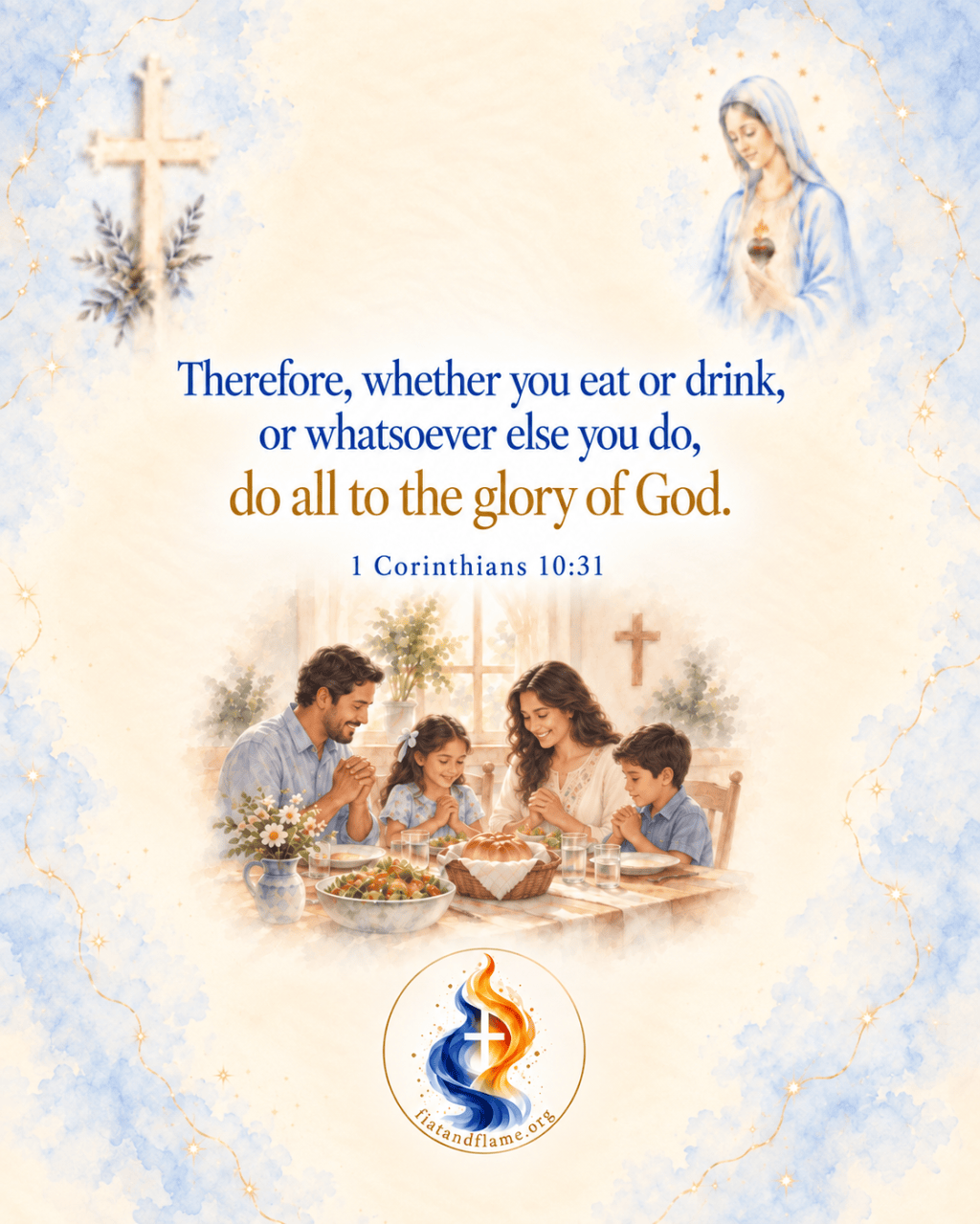
“So, whether you eat or drink, or whatever you do, do all to the glory of God.”
— 1 Corinthians 10:31
Eating is one of the most ordinary things we do, which may be exactly why St. Paul’s words are so striking. He does not reserve the glory of God for prayer, worship, ministry, or explicitly religious acts. He brings it directly to the table: whether you eat or drink, do it for the glory of God.
Our relationship with food can become a place where gratitude, freedom, self-control, generosity, prudence, and stewardship are practiced in ordinary ways. Food is one of God’s gifts, and Scripture gives us guidance for receiving that gift wisely.
From the beginning, food is presented as part of God’s provision. In Genesis, God gives plants and fruit for food, and later expands that provision after the flood. St. Paul echoes this goodness when he writes, “For everything created by God is good, and nothing is to be rejected if it is received with thanksgiving” (1 Timothy 4:4).
That word—thanksgiving—matters. Deuteronomy says, “You shall eat and be full, and you shall bless the Lord your God for the good land he has given you” (Deuteronomy 8:10). The Israelites were warned that abundance could lead them to forget the One who provided it.
A meal can remind us of our dependence on God. We may earn the money to buy food, prepare it ourselves, and make thoughtful choices about what we eat, but we still depend upon creation, the work of others, and ultimately God’s providence. Psalm 145 says, “The eyes of all look to you, and you give them their food in due season” (Psalm 145:15).
Scripture is also realistic about appetite. St. Paul writes, “‘All things are lawful for me,’ but not all things are helpful. ‘All things are lawful for me,’ but I will not be dominated by anything” (1 Corinthians 6:12).
That raises a worthwhile question: Am I free in my relationship with food?
Food can become connected to comfort, entertainment, reward, distraction, stress, boredom, or habit. St. Paul’s warning that some make their belly their god (Philippians 3:19) reminds us that appetite, like any other desire, can become disordered.
This is where self-control matters. Galatians names self-control among the fruits of the Holy Spirit. It gives us the ability to respond to desire thoughtfully instead of automatically. We can enjoy food, recognize when we have had enough, choose nourishment, fast when appropriate, and participate in celebrations without making appetite the center of our decisions.
St. Paul uses the image of an athlete when he says, “Every athlete exercises self-control in all things” (1 Corinthians 9:25). Training teaches us that habits can be formed and desires can be directed toward a larger purpose.
That connects naturally to the idea of Strength as Stewardship.
A useful question in caring for the body is: What am I preparing my body to do?
Health and physical capacity affect our ability to participate in the responsibilities of daily life. Strength may help us carry what needs to be carried, assist an aging relative, care for children or grandchildren, work, travel, serve, remain independent, or respond when someone needs practical help. Endurance, mobility, balance, and adequate nourishment all contribute to our ability to remain engaged in the life God has given us.
St. Paul says, “You are not your own, for you were bought with a price. So glorify God in your body” (1 Corinthians 6:19–20). He also describes the body as a temple of the Holy Spirit. These passages give the body both dignity and purpose.
Caring for health can therefore be part of stewardship. Eating nourishing food, maintaining strength, developing endurance, supporting mobility, resting, and recovering well can increase our capacity to fulfill our responsibilities and serve others.
St. Paul writes elsewhere, “Present your bodies as a living sacrifice, holy and acceptable to God” (Romans 12:1). A living sacrifice involves the whole person. Our physical lives—the work of our hands, the places our feet take us, our energy, our strength, and even our limitations—can all be offered to God.
The cardinal virtues also have a place at the table. Prudence helps us determine what is wise in our particular circumstances. Temperance helps us enjoy created goods in proper measure. Fortitude helps us remain faithful when forming better habits is difficult. Justice broadens our concern beyond ourselves and reminds us of our obligations toward others, including those who lack sufficient food.
Temperance is particularly relevant because eating involves both necessity and pleasure. Proverbs warns against gluttony because excess can damage our freedom and well-being. Temperance helps pleasure remain one part of a good life rather than allowing it to govern our choices.
Fasting develops this same freedom from another direction. Jesus fasted in the wilderness and, when tempted to turn stones into bread, answered, “Man shall not live by bread alone” (Matthew 4:4). Fasting reminds us that an immediate desire does not always have to be satisfied and directs our attention toward our dependence on God.
Scripture also makes clear that fasting must be connected to charity. Isaiah describes the fast God desires as one that includes sharing bread with the hungry and caring for the oppressed (Isaiah 58:6–7). Personal discipline has a larger purpose when it makes us more attentive to the needs of others.
There is also a proper place for celebration. Jesus attended meals and weddings, and His first public miracle took place at a wedding feast. Ecclesiastes says, “Go, eat your bread with joy” (Ecclesiastes 9:7). Fasting and feasting both belong within the Christian life when each is practiced at the appropriate time and in the appropriate spirit.
Meals also create fellowship. Acts describes the early Christians “breaking bread in their homes” and receiving their food “with glad and generous hearts” (Acts 2:46). Jesus frequently shared meals with others, including people who were rejected or judged by society. Hospitality gave the table a purpose beyond personal nourishment.
That social dimension should influence the way we think about food. A meal is sometimes about nutrition, sometimes about celebration, and sometimes about being present to another person. Wisdom requires recognizing which good is most important in a particular moment.
St. Paul cautions Christians against judging one another over eating and abstaining: “Let not the one who eats despise the one who abstains, and let not the one who abstains pass judgment on the one who eats” (Romans 14:3). He later explains that “the kingdom of God is not a matter of eating and drinking but of righteousness and peace and joy in the Holy Spirit” (Romans 14:17).
Our food choices can matter without becoming a standard by which we measure another person’s virtue. People have different bodies, health needs, circumstances, responsibilities, and convictions. Humility leaves room for those differences.
The same perspective is helpful when thinking about health and physical training. St. Paul says, “Bodily training is of some value” (1 Timothy 4:8). Physical training does have value, particularly when it helps preserve strength, mobility, health, and the ability to serve. Yet Paul places that value within the larger pursuit of godliness.
That matters because our bodies remain mortal. They age, become injured, develop illness, and change in ways we cannot always prevent. Good stewardship does not guarantee a particular physical outcome. It asks us to care responsibly for what has been entrusted to us while recognizing that our security ultimately rests in God.
Jesus’ words in the wilderness bring the whole subject back into perspective: “Man shall not live by bread alone.” Our bodies require food, while the deeper needs of the human person reach beyond food. Hunger may call for a meal, but loneliness, grief, fear, restlessness, and spiritual emptiness require different kinds of care.
Jesus says, “I am the bread of life” (John 6:35). For Catholics, those words lead naturally toward the Eucharist. At the Last Supper, Jesus took bread, gave thanks, broke it, and gave it to His disciples. Ordinary meals sustain our physical lives, while Christ gives Himself as the food of eternal life.
This helps put nutrition, health, and strength in their proper context. They are worthwhile concerns because our physical lives matter and because our bodies are involved in our vocations. They remain part of a larger Christian life centered on God, love of neighbor, and the hope of eternal life.
The goal, then, is faithful stewardship: receiving food with gratitude, developing reasonable self-control, caring for the body, sharing with those in need, practicing hospitality, and maintaining enough freedom around food that it can serve its proper purposes without dominating our attention.
Strength as Stewardship fits within that vision. Physical strength can support service, independence, responsibility, and generosity. Nutrition can support the work the body is called to do. Discipline can help form habits that make us more dependable and available to others.
St. Paul’s instruction remains a simple standard for all of it:
“So, whether you eat or drink, or whatever you do, do all to the glory of God.”
— 1 Corinthians 10:31
The ordinary act of eating can become one more part of a life offered to God.


Leave a Reply